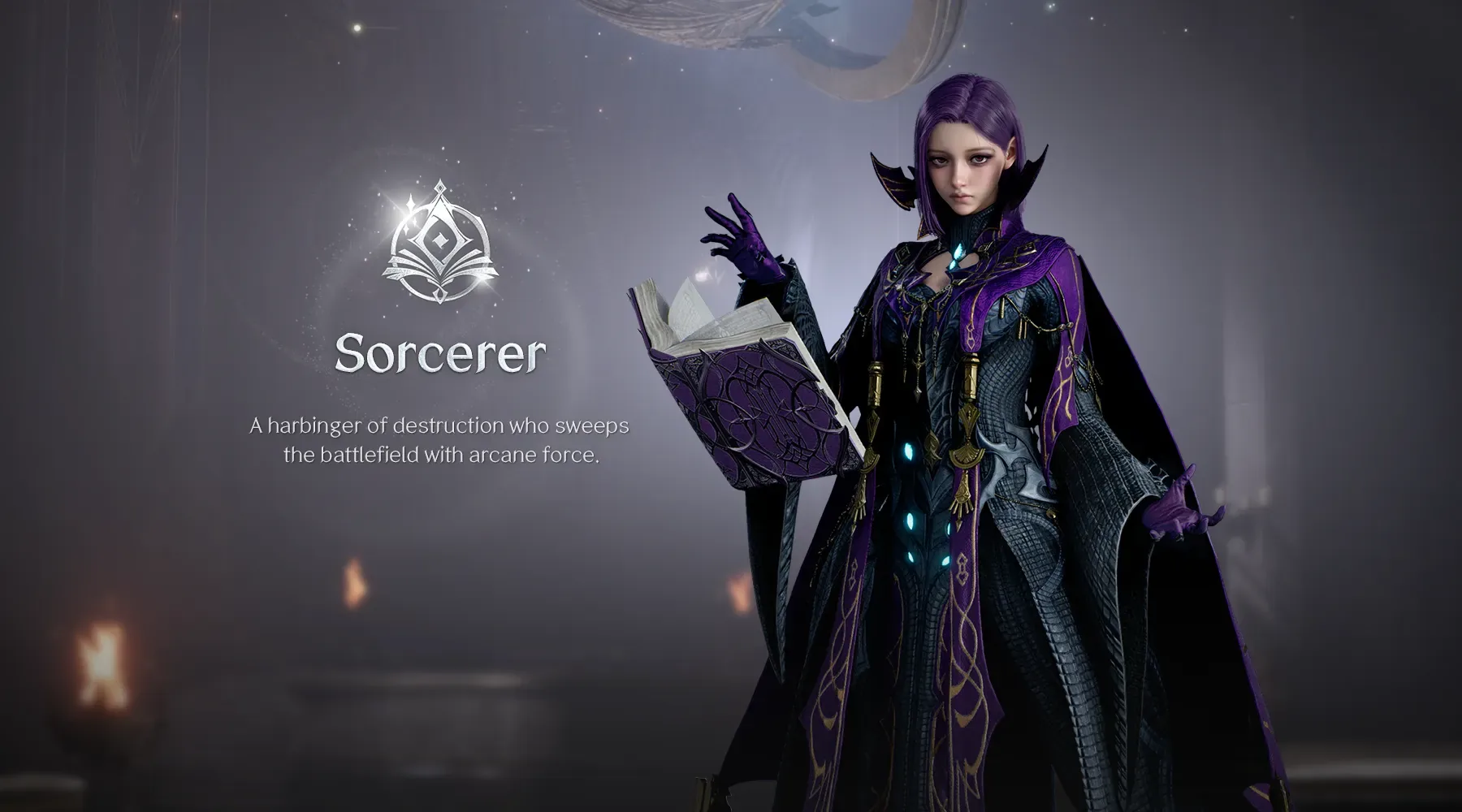
AION 2 Sorcerer is a ranged spellbook class that combines fire damage with ice control. Its central challenge is creating safe casting windows while managing position, MP, and defensive tools.
Choose Sorcerer if you enjoy reading an encounter before committing to an attack. A strong spell is useful only when it lands and leaves you able to respond to the next mechanic. This page explains the decisions behind the class rather than prescribing a complete skill build or a fixed damage rotation.
Understand the class before judging its damage
Sorcerer uses fire and water magic to attack at range. Fire skills create damage opportunities and interact with effects such as Fire Mark. Ice skills offer movement control, including slows and roots, alongside damage. These families give the class several ways to influence a fight, but they do not remove the need to move out of danger.
The class has a vulnerable defensive profile. Range reduces some exposure, yet enemies can close distance, attack across an arena, or force the entire party to change position. Treat safe distance as a condition that you keep creating, not a permanent shield granted by choosing a caster.
A useful Sorcerer player therefore watches two layers of combat. The first is the target: its movement, attack direction, and vulnerability. The second is the arena: safe ground, incoming hazards, and where allies will need to stand. Damage decisions become easier once these two layers agree.
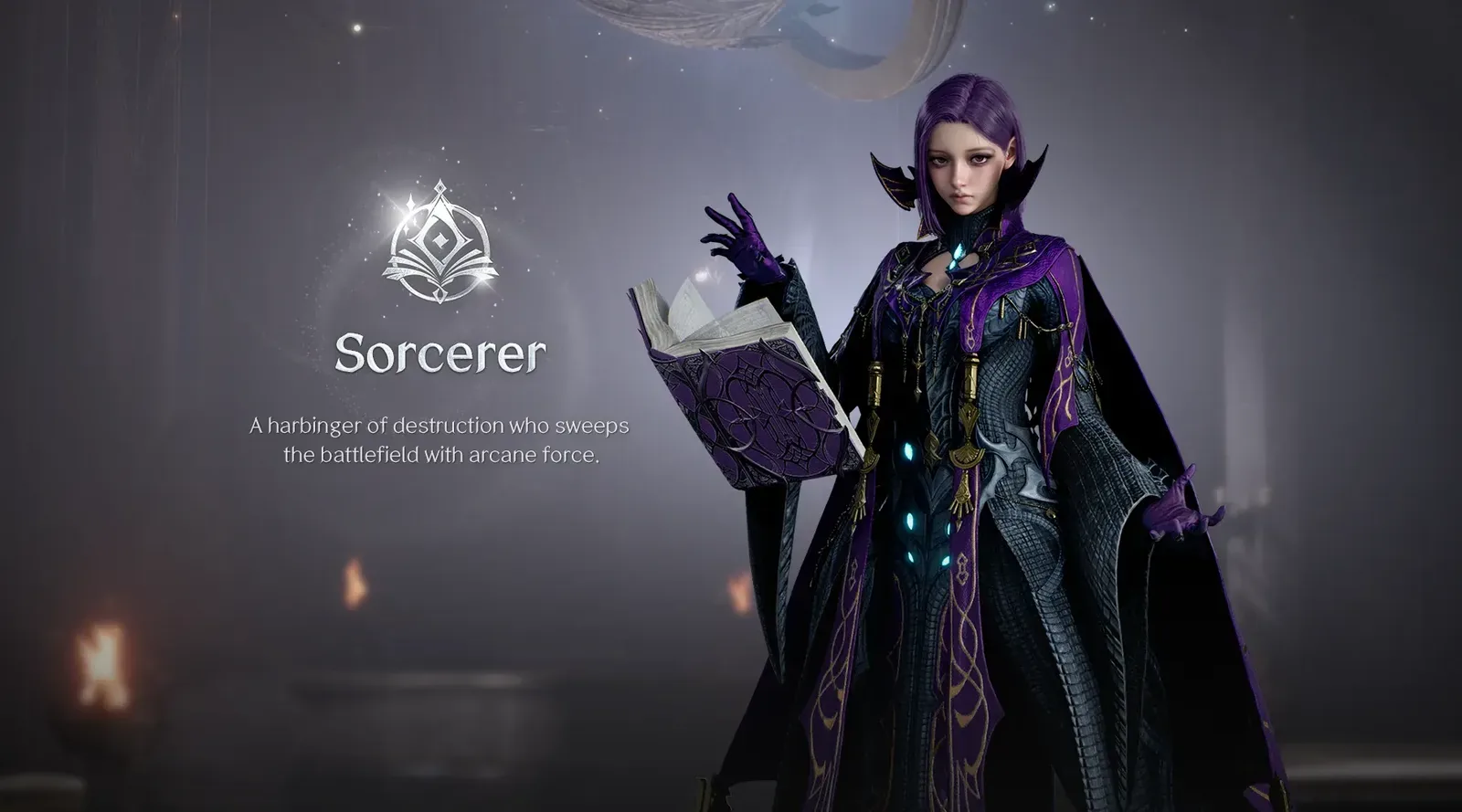
Official character artwork identifies the class; it does not illustrate an active combat sequence.
Learn what a charged cast asks from you
Hellfire is a charged skill with multiple charge stages. The important input distinction is holding the activation rather than simply tapping it. A brief press and a completed charge are different actions, so practice the input deliberately before relying on the skill in a difficult encounter.
During a charge, ask whether the target and the ground will remain suitable until the attack resolves. A boss standing still now may be about to move. A safe patch beneath your feet may become dangerous before the cast finishes. The time available is therefore more important than the visual impression that the enemy is currently idle.
Begin practicing on an uncomplicated target where you can observe the charge feedback. Learn how the skill signals its stages and release. Then repeat while watching the environment instead of staring exclusively at the button. This teaches you to preserve awareness during the action that demands commitment.
Some skill specializations change casting behavior, including movement options. Judge the actual version and specialization available to your character. Do not assume that a video showing mobile casting represents your current setup, and do not build an encounter plan around an option you have not selected.
Create a casting window instead of hoping for one
A casting window is a stretch of time in which you can commit without neglecting the next required response. In a party encounter, it can appear after the boss finishes a dangerous attack, during a predictable stationary sequence, or once the group has reached its next safe position.
The sequence of decisions is simple: identify the upcoming threat, move where you will be safe, then commit to the cast that fits the remaining time. Reversing that order often creates an avoidable interruption. Starting a long spell before deciding where to stand makes movement feel like a punishment instead of a planned part of combat.
Not every available window deserves the longest action. If an enemy is already moving away or a mechanic is about to divide the arena, choose an action you can finish and prepare for the transition. A shorter useful attack is preferable to spending the entire interval charging at a target that will leave.
When learning a new boss, observe the pattern before trying to maximize output. Notice which animations consistently precede movement and which pauses are actually safe. Your cast selection should become more confident as your knowledge improves, rather than remaining equally aggressive through every unknown sequence.
Use fire effects with a clear target plan
Fire attacks provide the class's direct offensive identity. Effects associated with Flame Arrow, Blaze, Fire Mark, and Hellfire create reasons to remain attentive to the same target rather than scattering every action across unrelated enemies.
This does not mean that one target must be attacked regardless of circumstances. A priority add or a mechanic can require a switch. The useful question is whether changing targets serves the encounter. If the group needs an add removed immediately, respond to that need instead of protecting an ideal sequence on the boss.
When several enemies are present, look at where they will actually stand. Persistent area attacks lose value when placed where targets have already finished moving. A tank gathering enemies or a predictable approach route can make placement more deliberate. Coordinate with that movement instead of assuming the first visible position is the final one.
Fire effects also create visible clutter. Keep the boss's cues and your own safe ground readable. A spell's visual intensity is not evidence that standing inside another effect is safe. Learn the distinction between your attacks, friendly effects, and encounter hazards.
Treat ice control as a tactical resource
Ice Chain slows, Bittercold Wind can root, and Frost can create a condition for Frost Burst. These effects offer ways to change an enemy's approach or support a follow-up action. Their usefulness depends on whether the target can receive the relevant condition.
Player targets, ordinary enemies, and bosses do not necessarily respond identically. Do not assume that a control effect which worked on a field enemy will immobilize a dungeon boss. Look at the actual result and adapt when an enemy remains mobile.
Against an approaching opponent, control can create time to move, finish another action, or protect an ally. Decide which outcome you need before using it. Slowing an enemy while remaining in its attack path wastes part of the opportunity. Use the changed movement to improve your own position.
A conditional follow-up needs its actual prerequisite. Read the effect on the target rather than pressing the next skill because enough time has passed. If the required condition did not apply, avoid interpreting the failed follow-up as an input problem without checking the target state first.
Manage MP as both offense and defense
Sorcerer consumes MP to sustain its spell use, and some of its defensive interactions also depend on that resource. An empty or poorly maintained MP pool can therefore affect more than the next damage skill.
Flame Arrow and Blaze have MP recovery interactions described in the class's skills. Understand which actions available to your character help replenish the resource, then watch whether those actions are actually reaching their targets. A recovery plan that depends on successful hits can become unreliable during movement or target loss.
Do not wait until every planned action becomes unavailable to notice resource pressure. Check MP during transitions, after an extended offensive stretch, and before choosing a defensive response whose benefit depends on it. These are natural checkpoints that avoid watching the resource bar constantly.
If you repeatedly exhaust MP during the same encounter phase, review your decisions in that phase. Were you spending into targets that moved away, repeatedly casting without a safe window, or neglecting available recovery actions? Correcting waste can be more useful than assuming the class requires a completely different identity.
Choose defensive tools for the actual danger
Steel Barrier and Arctic Armor belong to the Sorcerer's protective toolkit. Arctic Armor includes an MP-related defensive interaction, so its effectiveness must be considered alongside resource state. It should not be treated as permission to ignore an arena mechanic.
Hibernation offers a temporary protective state. Some powerful attacks can exceed the protection described for the skill, so identify the incoming mechanic instead of assuming universal invulnerability. Remove Hibernation lets you end the state and return to movement, with a backward displacement and recovery interaction described in the skill.
The exit deserves as much attention as the entry. Before choosing a defensive state, consider where you will stand afterward and what the enemy will do next. Ending protection into a second hazard can undo the benefit of surviving the first attack.
| Immediate problem | Decision to make | What to observe afterward |
|---|---|---|
| Incoming damage while you can move | Reach safe ground and use an appropriate protective tool | Whether the next safe area remains reachable |
| Pressure requiring temporary protection | Decide whether the attack fits the tool's protection | The enemy's next action and your exit position |
| MP becoming low during pressure | Avoid assuming an MP-dependent defense is fully available | Resource recovery and the remaining escape route |
| An ally being threatened | Consider useful control without abandoning your own safety | Whether the enemy actually received the effect |
Coordinate control with your party
Curse: Tree is a control effect that can end when the target takes damage. In a group, this creates an obvious coordination problem: an ally's attack may remove the condition you intended to preserve. Communicate the purpose of the control instead of assuming everyone will infer it from the animation.
Soul Freeze provides a sealing effect. As with other control, confirm that the target can receive it and that it serves the current group objective. A control button used without a target plan is less useful than one reserved for a dangerous opponent at the right moment.
When the party moves, move with its safe structure. Being at range does not justify remaining far behind when a mechanic requires grouping. Likewise, standing directly beside every ally can reduce room to avoid an attack. Choose the position that preserves both your access to the target and the group's encounter plan.
If a teammate calls for a target switch, respond promptly. Your role is ranged damage with useful control, not uninterrupted attention to one preferred boss target. A successful group can need several different contributions within the same minute.
Decide whether Sorcerer suits your playstyle
Sorcerer suits players who enjoy planned commitments, visible resource management, and control effects that require attention to the target. It rewards learning which moments support a charged spell and which require a quick movement decision.
It is less comfortable if you want every action to remain equally useful while moving without preparation. The class can adapt, but its distinctive tools still ask you to judge the window in front of you. That is a learning requirement rather than a reason to declare the class weak.
During your first sessions, assess three habits: can you watch mechanics while charging, can you preserve enough space to move, and can you distinguish a failed condition from a failed input? Improvement in these habits makes the class easier to understand before you begin optimizing a build.
A productive practice session has one clear objective. Focus on completing a charge safely, applying control before repositioning, or leaving a defensive state in a useful location. Add more complex choices once that objective feels reliable. This keeps the class's many tools connected to specific combat problems instead of becoming a list of buttons to press whenever they light up.
Sources and verification
Reviewed for Global on October 10, 2026. The linked independent class guides inform the skill explanations. Check current Global tooltips and unlocked specializations before copying a build; the advice here is editorial and has not been benchmarked in game.
- Sorcerer Class Guide: Skills and How to Play | AION 2
- Aion 2 Sorcerer Hellfire PvE Build
- Sorcerer - Aion 2 Wiki