Arcana cards add character stats and extra levels to regular class skills. For a first usable setup, fill the available card slots, keep bonuses for skills your build actually uses, and compare the equipped result before consuming spare cards. Transcendence rewards and Transmutation are the main acquisition routes described by Odealo’s independent Global guide.
This guide covers the five-slot Global Season 1 setup: Chalice, Parchment, Compass, Bell and Mirror. Later Korean and Taiwanese card types are not a shopping list for the current Global release. Exact recipe costs, dungeon admission conditions and reward odds should be checked in your current client before you spend materials.
Understand what each card slot changes
A card's slot and its set are separate choices. The slot determines its skill pool; the Vigor or Magic family changes its stat package and set membership. Two cards called Bell can therefore support different stats while belonging to the same broad skill category.
| Slot | Skill role | What to compare |
|---|---|---|
| Chalice | Broad pool of regular active and passive skills. | Whether it improves the most important parts of your actual build. |
| Parchment | One group of active skills. | The active skills listed in the card's current preview. |
| Compass | The other group of active skills. | Whether your missing active-skill bonus belongs to this pool. |
| Bell | One group of passive skills. | Useful passives and the card's main stat together. |
| Mirror | The other group of passive skills. | Useful passives, cooldown or resource needs and set fit. |
Stigma skills are not part of these regular Arcana skill pools. If the ability you want is missing from the preview, check whether it is a Stigma or belongs to another card slot before crafting.
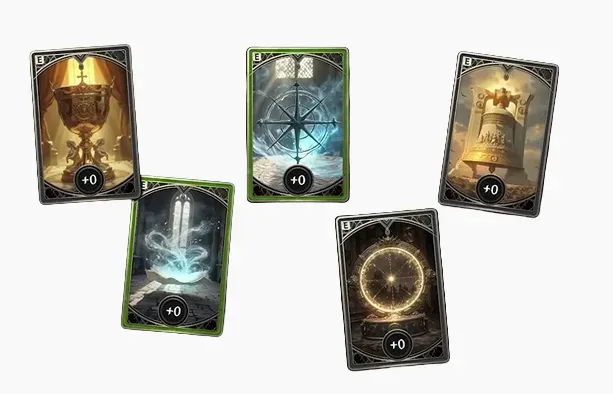
The card shape identifies its slot; the skill pool differs by slot.
Rarity is useful information, but it is not the whole comparison. A higher-grade card with irrelevant skill lines can increase the displayed Item Level while removing a useful level bonus from your rotation. Read the actual skills on both cards, then check the resulting skill panel after the swap.
Get cards from the reward you need
Current Global guides identify Transcendence dungeons as the main card source. Deus Research Base is associated with Chalice, Compass and Bell; Shattered Arkanis is associated with Chalice, Parchment and Mirror. Use that distinction to target a missing slot instead of repeatedly running a dungeon that does not list it.
- Open the Transcendence activity menu.
- Select a dungeon and difficulty that your character can enter and your group can clear.
- Inspect its Cube Reward information and the available reward preview.
- Confirm that the desired card slot and grade appear before committing to the run.
- Check the live claim cost and remaining reward allowance before opening the reward cube.
The reward preview is especially important for Chalice. Its available grade can differ from the other card slots at the same difficulty. A guide saying that a stage drops Unique cards does not establish that it drops a Unique Chalice.
Fixed stage thresholds and drop percentages are not included here because published guides disagree on several of them. The useful decision remains specific: choose the dungeon whose current reward panel contains your target, at a difficulty you can reliably clear and claim.
Equip a first setup before chasing perfect rolls
For an incomplete collection, an empty slot is usually the first problem to solve. Equip a usable card in each available slot, then review the combined setup instead of waiting for five perfect drops.
For each replacement, compare:
- Skill effects: does it raise a regular active or passive skill that you use?
- Resulting skill level: will the swap gain or lose a specialization threshold shown in your skill panel?
- Main stats: does the stat solve damage, accuracy, survival or resource pressure for your role?
- Set effect: does the swap activate or break a useful matching-piece bonus?
- Entry progress: does the Item Level change help with the next activity's actual requirement?
Do this comparison in the same build and equipment preset. Otherwise, a changed weapon, skill selection or buff can make the Arcana swap look responsible for a difference it did not cause.
Choose Vigor and Magic by their effects
Primal Vigor and Magic Armor are the two set families described for the five-slot setup. Matching two or four cards activates their respective set effects. Read the current tooltip, including any HP or MP condition, when deciding whether that bonus fits the content you are playing.
Do not interpret “Magic” as a rule that only spellcasters should use it. Bell of Magic is associated with an Attack stat, while Vigor includes effects such as Combat Speed and Cooldown Reduction across its slots. Compare the individual card before deciding that its family name makes it wrong for your class.
A Vigor core with a useful Magic off-piece is a common recommendation in independent Global PvE guides. It is a starting comparison, not a universal best setup: a tank dealing with lethal damage and a support character running out of MP have different immediate problems from a damage dealer with stable resources.
Use the cards you own to solve the current problem. Do not preserve a nominal set at the cost of losing a skill bonus that makes the build function.
Use Enhancement after checking the base skills
Arcana Enhancement uses spare cards as experience. It improves the card you keep, but skill-level gains can land on existing skill lines. A card with several irrelevant lines remains a poor target for expensive investment even when its border looks attractive.
Before adding materials, read the enhancement preview and inspect the skills already present. Improve a card because its slot, set and useful skill lines fit the build. If you are planning a near-term replacement, compare the expected improvement with the cost shown rather than automatically pushing every card to its maximum.
Spare cards also have a competing use: extraction for crafting materials. Decide what you need next before selecting a batch. A card kept for a second role or a useful alternative setup should not be consumed merely because its grade is lower than your newest drop.
Transmute to fix a specific gap
Transmutation can target a card slot and set using Mysterious Crystals. Targeted skill choices and their costs must be read from the current recipe. Published examples disagree about which skill guarantees are included in the base price, so a five-crystal example should not be assumed to produce every desired skill for the cheapest recipe.
- Identify the exact slot holding your build back.
- Open the recipe for the intended set and card type.
- Inspect its allowed skills and the guarantee offered by the selected options.
- Read the total Mysterious Crystal and Kina cost after those options are selected.
- Confirm what remains random before crafting.
Chalice is a reasonable slot to investigate when random drops repeatedly miss your core skills because its skill pool is broad. That does not make an expensive Chalice the right first craft for every character: a missing ordinary slot or a near-term equipment gate can be the more immediate problem.
Crystals are described in current guides as coming from unwanted-card extraction, eligible Season Shop purchases and Ascension Trial season objectives. Check the reward that is actually claimable on your account. Do not treat an example score, an old shop listing or an advertised clear time as a guaranteed crystal source in every version.
Check the card after every meaningful change
Equip the result, open the relevant skill panel, and confirm that the intended bonus applies. Then check the set bonus and the stat that motivated the change. If the goal was admission, revisit that activity's requirement; if the goal was a skill threshold, inspect the skill rather than judging success from Combat Power alone.
Keep the previous useful card until the replacement has been checked. This gives you a practical alternative when a higher-grade drop improves one number but weakens an important skill or a role-specific stat.
Related progression guides
- Where to spend Odyle Energy helps compare an Arcana reward with an immediate equipment reward.
- Daevanion Board priority covers the other skill-level decisions that affect your final setup.
- How to increase Combat Power helps distinguish a useful skill upgrade from a displayed-score change.