
The correct AION 2 Steam chart uses App ID 3393110. Its concurrency figures represent people connected through Steam at the same time, not copies sold, registered accounts, or the complete population across every launcher. Steam’s Top Sellers chart is a revenue ranking, so reaching number one there does not mean AION 2 had the most players or downloads.
Charts and App Links
As of October 9, 2026, the strongest verified launch statement is that NC reported more than 400,000 concurrent players immediately after the October 5 Global launch. That announcement did not provide a platform split, so the figure must not be presented as a verified Steam-only peak. A separate report placed the paid Early Access Steam peak above 170,000, but that is a historical pre-launch comparison rather than a current player count.
| Signal | Correct interpretation | It does not prove |
|---|---|---|
| Current players | Steam users connected at one moment | Total Global population |
| 24-hour peak | Highest simultaneous Steam count during the previous day | Unique daily users |
| All-time peak | Highest observed Steam concurrency | Long-term retention |
| Top Sellers rank | Relative Steam revenue over the chart period | Units sold or player count |
| Popular New Releases | Launch visibility within Steam’s new-release grouping | A fixed number of players |
| Trending Free | Momentum among free products on Steam | Revenue, retention, or service health |
Find the correct AION 2 chart
AION 2’s Steam identity matters because several similarly named pages can produce a convincing but completely wrong result. The Global PC release is attached to App ID 3393110. Check that number before recording a live count, peak, or trend.
Do not use App ID 261430 for this page. That belongs to the original AION rather than AION 2. App ID 1146720 is also wrong because it identifies an AION translation application, not the Global AION 2 game client. A chart bearing the AION name is therefore insufficient evidence by itself.
Use this identification sequence whenever you inspect a chart:
- Confirm that the displayed product name is AION 2.
- Confirm that the URL or page metadata contains App ID 3393110.
- Check the timestamp and time zone attached to the displayed value.
- Identify whether the number is current concurrency, a daily peak, a monthly average, or an all-time peak.
- Record the launcher scope as Steam only unless the publisher explicitly defines a broader figure.
A valid chart can still be stale. Some third-party pages cache Steam information and show the time of their last refresh. A number without its observation time is difficult to compare with another snapshot, especially during launch week when traffic can change sharply within hours. Treat the timestamp as part of the value rather than optional fine print.
Steam concurrency measures simultaneous sessions
A Steam concurrency chart answers a narrow question: how many Steam accounts were running the game simultaneously at each recorded moment. It is useful for comparing daily cycles, launch peaks, maintenance gaps, and the direction of activity over time. It does not directly count everyone who played during a day.
Ten people who play at different times can contribute to daily activity without ever appearing together in one concurrent count. Conversely, one long session can remain present across several chart samples. This is why concurrency cannot be converted into daily active users, registered accounts, downloads, or paying customers without additional data.
Current players
The current value is a momentary Steam snapshot. It can move because players log in or out, because different regions enter prime time, or because servers become unavailable. A single current value is useful for a quick status check but weak evidence for a population trend.
Do not call the current figure the number of “active players” unless the label clearly means concurrent Steam players. “Active players” is often used loosely for daily or monthly users, which are different measurements.
The 24-hour peak
The 24-hour peak is the highest simultaneous Steam count observed during the preceding 24 hours. It smooths away some minute-to-minute noise, but it still covers only one daily cycle. It is especially sensitive to launch events, weekends, maintenance, and regional play schedules.
Compare 24-hour peaks taken at consistent times. A snapshot captured before the day’s busiest period is not directly comparable with one captured just after it. During the first launch week, a one-day comparison is too short to establish durable growth or decline.
The all-time peak
The all-time peak records the largest observed Steam concurrency since tracking began. It is a milestone, not a description of the current audience. A game can retain a healthy community while sitting well below its launch maximum, and a large opening peak cannot guarantee that players will remain.
For AION 2, launch conditions also changed during the first week. Paid Early Access began on September 30, while free Global access began on October 5. Peaks from those periods describe different access conditions and should not be placed in one table without clear labels.
Monthly averages
A monthly average normally summarizes concurrency readings collected throughout a calendar month or rolling period. AION 2 had not accumulated 30 post-launch days by October 9, 2026. Any page already presenting a complete “last 30 days” launch average needs careful scrutiny because most or all of that period predates the free Global launch.
One available third-party page displayed mutually inconsistent current values and a 30-day statistic before 30 post-launch days existed. Its figures should not be reproduced as a dependable current snapshot. Wait for a coherent observation window and retain the provider’s timestamp when comparing later months.
Revenue charts use a different unit
Steam’s Top Sellers chart ranks products by revenue during its applicable chart window. It is not a unit-sales leaderboard and it is not a concurrent-player chart. Revenue can include game packages and eligible in-game spending processed through Steam.
That distinction was particularly important during AION 2’s paid Early Access. Founder’s Packs granted entry five days before the free Global launch and were offered at multiple price tiers. Players paying different amounts could therefore contribute different revenue while each still represented one concurrent session when online.
A high Top Sellers position can coexist with a lower concurrency rank when spending per customer is high. The reverse can also happen when a free product attracts many players who spend little through Steam. Never calculate player numbers by dividing a chart rank or estimated revenue by one package price; the necessary transaction mix is unknown.
NC reported that AION 2 held the number-one position on Steam’s Global Top Sellers chart from the September 30 Early Access opening and also led territory charts in 15 markets. The publisher’s October 6 announcement additionally listed number-one positions in Top Sellers, Popular New Releases, and Trending Free. These are three separate Steam chart categories, not three confirmations of the same player-count statistic.
The launch figures need precise labels
The launch record contains useful signals, but each belongs to a specific time and scope.
| Date or period | Reported signal | Safe conclusion |
|---|---|---|
| September 30, 2026 | Paid Early Access opened on Steam and PURPLE | Access was limited to Founder’s Pack owners during this phase |
| Early Access period | A secondary report placed the Steam peak above 170,000 | Steam concurrency exceeded 170,000 during paid Early Access according to that report |
| October 5, 2026 | Free Global launch | The access conditions changed, so later peaks are not directly equivalent to Early Access peaks |
| Immediately after launch | NC reported more than 400,000 concurrent players | The service had a large launch audience, but the announcement did not establish a Steam-only platform split |
| October 6 announcement | Number one in three Steam chart categories | AION 2 combined strong Steam revenue and launch visibility at that dated snapshot |
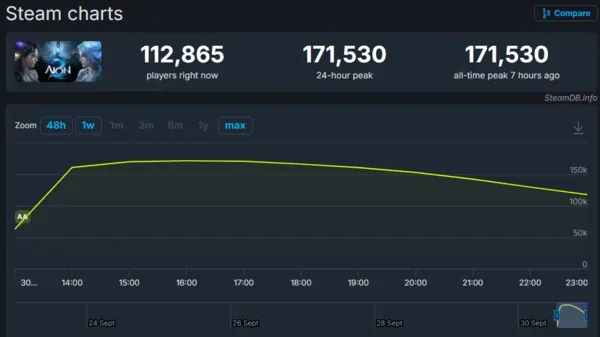
Historical Steam concurrency snapshot; figures and date labels belong to the captured chart and are not live counts.
The wording around the 400,000-plus figure requires special care. NC’s announcement stated that AION 2 amassed that concurrency immediately after launch, then separately described its Steam chart positions. It did not break the total into Steam and PURPLE players. Headlines that shorten the claim to “400,000 on Steam” remove an important limitation.
The figure is also dated. It describes the immediate launch period, not how many people are playing at the moment this page is read. A current Steam count must come from a correctly identified, timestamped App ID 3393110 chart.
Steam is only part of the Global service
The Global Windows PC version runs through both Steam and NC’s PURPLE platform. The two clients provide the same game content and share servers, but Steam’s public concurrency data can observe only sessions launched through Steam.
This creates an important measurement boundary:
- Steam concurrency is a visible subset of the Global audience.
- PURPLE players can affect shared-server activity without appearing in Steam’s count.
- A publisher-wide CCU statement may include more than Steam unless the announcement explicitly says otherwise.
- Neither Steam nor a combined CCU figure reveals how players are distributed across individual servers.
A declining Steam line could reflect lower overall activity, a changing launcher mix, or both. Public Steam data alone cannot separate those explanations. It also cannot establish whether a specific server is crowded, available for character creation, undergoing maintenance, or suitable for a friend group. Those questions belong to current server notices and server-specific information rather than population-chart inference.
Korean and Taiwan services are another separate scope. Their players, platforms, versions, and launch history should not be combined with Global Steam App ID 3393110. A chart or article discussing those services does not become Global evidence merely because the game name is the same.
Read the trend without overclaiming
A useful trend analysis compares equivalent measurements rather than isolated impressive numbers. Start with timestamped daily peaks from the same provider. Mark launch, maintenance, and major access changes, then allow enough ordinary days to establish a baseline.
Use comparable observation windows
Compare one complete weekday with the same weekday in a later week when possible. Weekend and weekday traffic can differ, while launch week is structurally unusual. Do not compare an Early Access peak available only to paying customers with a later free-access low and describe the percentage change as pure retention.
Monthly averages become more informative after a full month of consistent service has elapsed. Even then, label partial months and rolling 30-day windows separately. They answer different questions and can contain different mixes of launch days, maintenance, and ordinary play.
Separate data from explanations
The chart can show that concurrency rose or fell. It cannot by itself prove why. Monetization, competing releases, technical problems, content pacing, and regional schedules may all be proposed explanations, but the line alone does not select one cause.
Community comments from launch week included both enthusiasm and predictions of rapid decline. Those reactions demonstrate disagreement, not a measured retention outcome. Use later chart observations to evaluate retention instead of turning early opinions into facts.
Treat maintenance gaps carefully
A sharp drop toward zero can indicate maintenance or a tracking interruption rather than mass abandonment. Check the time window before interpreting the move. When service returns, compare the next complete peak with an equivalent earlier period instead of using the maintenance trough as the baseline.
Likewise, a brief surge can reflect launch access opening, a major update, or an event. It should be labeled as an event-period peak until ordinary activity shows whether the increase persisted.
Avoid the most common chart errors
The following mistakes produce misleading AION 2 population claims:
- Using the original AION chart under App ID 261430.
- Treating the AION translation application as the game.
- Calling Top Sellers a player-count or download ranking.
- Reporting the publisher’s 400,000-plus launch CCU as verified Steam-only concurrency.
- Presenting a cached third-party value as live without its refresh time.
- Treating Twitch viewers as players. Viewership measures a streaming audience, not in-game sessions.
- Treating Google search interest as a population count. Its relative index measures search attention within its own scale.
- Using one launch-day peak to predict long-term retention.
- Combining Steam, PURPLE, Korean, and Taiwan figures without explicit platform and service labels.
- Describing a partial launch month as a complete 30-day post-launch sample.
A reliable snapshot format
When saving or sharing an AION 2 Steam chart result, record enough context for another reader to interpret it later:
| Field | What to record |
|---|---|
| Product | AION 2 |
| Steam App ID | 3393110 |
| Metric | Current, 24-hour peak, all-time peak, or average |
| Value | Exact displayed number without rounding |
| Observation time | Date, time, and stated time zone |
| Provider | Steam or the named third-party tracker |
| Refresh status | Live, delayed, or cached when disclosed |
| Service scope | Steam only |
| Event context | Launch, maintenance, update, or ordinary day |
This format preserves the difference between what the chart measured and what a headline inferred. For October 2026 launch comparisons, keep the September 30 paid Early Access period separate from the October 5 free Global launch. Use the 400,000-plus publisher figure only as a dated, platform-unsplit launch statement, and use App ID 3393110 for any Steam-specific concurrency reading.
Next Guides
Interpret counts alongside the Steam platform, actual service boundaries, and evidence-based game assessment.