
AION 2 is a third-person fantasy action MMORPG built around manual skill use, combo decisions, movement, free flight, exploration, and online encounters. Global currently centers on eight classes and progression to level 45. You can complete parts of PvE alone, but Expeditions, raid-format encounters, faction conflict, and other multiplayer activities make group play a major part of the wider game.
The main limitation is version context. Global launched on October 5, 2026 with a modified Season 1 build for Windows PC, while Korean and Taiwan services contain later content. Features associated with level 50, the Brawler class, or later regional updates should not be treated as part of the current Global gameplay loop.
The core AION 2 gameplay loop
Most play alternates between directed progression and activities you choose from the surrounding world. The main story introduces combat and systems while taking your character toward level 45. Exploration adds side objectives, gathering, feathers, field encounters, and other map discoveries. More structured combat comes through solo bosses, five-player Expeditions, and larger encounter formats.
The immediate loop is straightforward:
- Travel through the world on foot, by mount, through Windstreams, or with your wings.
- Fight enemies using class skills, linked attacks, movement, and defensive reactions.
- Complete story objectives, exploration tasks, dungeons, and multiplayer activities.
- Earn equipment and unlock additional character-growth systems.
- Return to harder encounters with better preparation and a stronger grasp of mechanics.
Reaching level 45 does not finish character progression. Equipment, Daevanion development, Stigma skills, Arcana, and permanent map-based gains continue afterward. Those systems have their own priorities and costs, so this overview does not turn them into a level-cap checklist. Use the dedicated level 45, Combat Power, enhancement, and Odyle dungeon guides when you need an upgrade route rather than a description of how the game plays.
Combat is built around manual skill use
Combat asks you to operate your class directly instead of watching an automated battle. Skills can connect into chains, and effective play depends on choosing the right sequence while continuing to move. Positioning matters because enemies and bosses use visible danger areas, targeted mechanics, and attacks that must be avoided rather than absorbed without thought.
A typical fight has several simultaneous decisions:
- Maintain an effective attack or support sequence instead of pressing every available skill immediately.
- Watch the enemy animation and ground indicators so you can move before a large attack resolves.
- Preserve the skills needed for healing, defense, control, or a mechanic rather than spending them only for damage.
- Reposition without losing awareness of allies, especially when an effect follows a marked player.
- Use flight when an encounter permits or requires vertical movement.
The result is a hybrid action-MMO rhythm: a skill bar and defined class roles sit alongside active movement and encounter reactions. Early enemies may fall before a full sequence becomes necessary, but bosses give those chained skills, cooldown choices, and defensive movements more purpose.
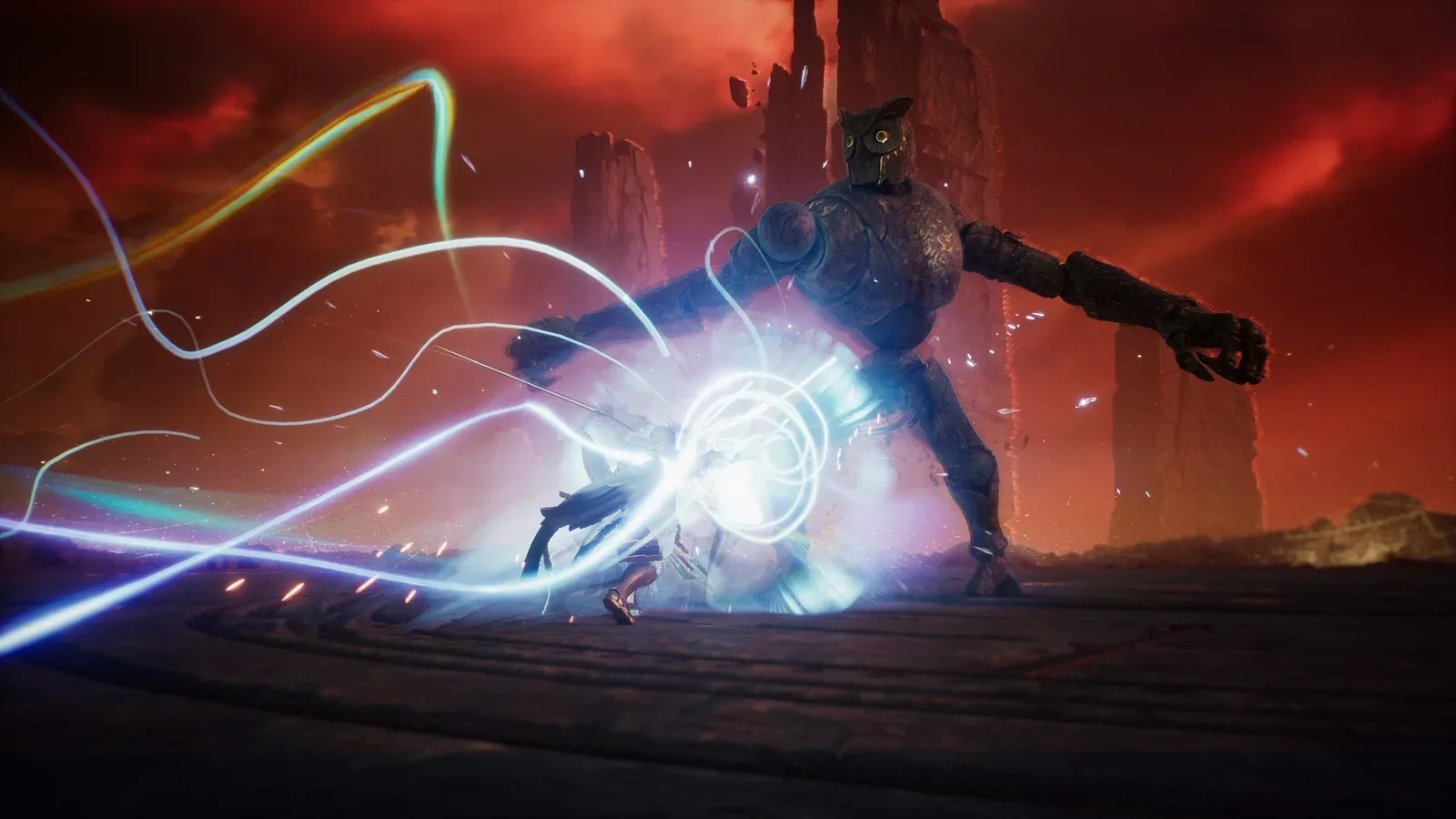
The combat frame shows attack effects and the distance between the character and a large enemy.
Global has eight classes: Gladiator, Templar, Assassin, Ranger, Sorcerer, Spiritmaster, Cleric, and Chanter. At a high level, they cover heavy melee, tanking, stealth attacks, ranged bow combat, elemental magic, summoned spirits, healing, and hybrid support. That description is enough to understand group composition, but it is not a ranking or build recommendation. Class balance and detailed skill setups belong in the dedicated class and build guides.
Movement, flight, and vertical exploration
Flight is not merely a shortcut between two distant objectives. It is part of traversal, exploration, collection, and combat. The Global presentation described takeoff through a double jump and showed flight operating across the open world rather than being limited to a small set of designated flight zones. Official launch material also presents underwater diving and aerial combat as supported parts of play.
Wings determine more than appearance. Earned wing sets can carry flight power, which governs how long you remain airborne. Cosmetic wing appearances use a separate visual role, so an attractive purchased skin should not be confused with the gameplay value of an earned wing set. Exploring and clearing content can therefore improve both how your character looks and how effectively you travel.
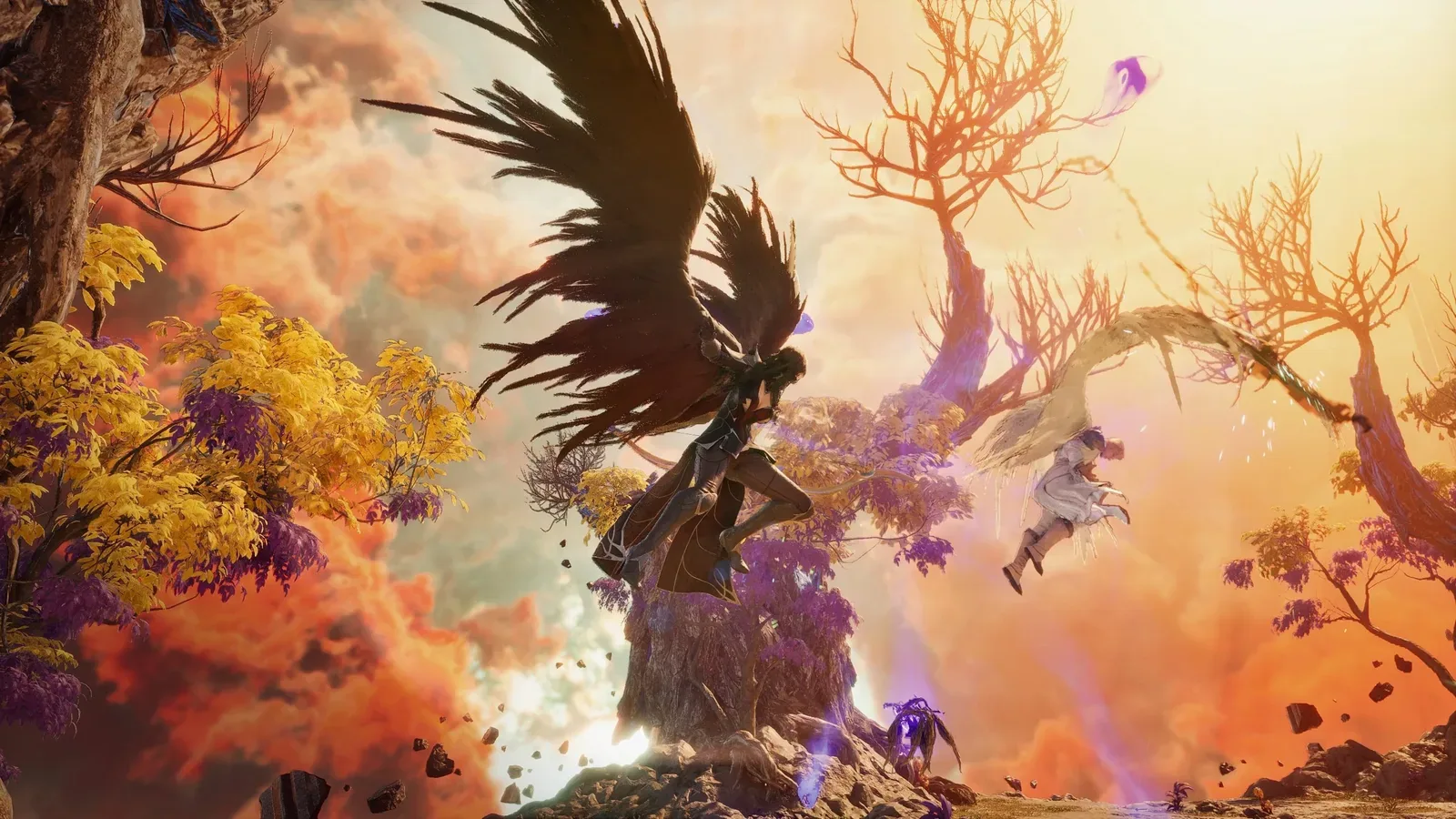
The elevated view shows flight as a way to cross terrain and explore Atreia.
Useful movement choices serve different situations:
| Movement option | Best use | Important distinction |
|---|---|---|
| Ground movement | Precise exploration and nearby objectives | Keeps you close to interactable objects and enemies |
| Mount riding | Faster travel along accessible terrain | Riding is separate from having a pet following you |
| Free flight | Crossing height differences, reaching elevated areas, and aerial play | Air time is constrained by flight power |
| Windstreams | Moving between connected points in the world or a dungeon | The showcased Windstreams do not consume wing stamina |
| Underwater movement | Reaching submerged spaces and continuing exploration below the surface | It is a distinct traversal state, not ordinary flight |
Verticality changes how you read the environment. A marker that appears close on a flat map can still be above or below you, behind terrain, or reached more easily from the air. Before assuming an objective is blocked, check its elevation and nearby approach routes. Save enough flight power to land safely rather than using the entire resource on the outward trip.
Solo, dungeon, and raid encounter formats
AION 2 separates PvE into formats with different social and mechanical demands. Some content supports solo play, while other activities are explicitly designed for coordinated groups.
Nightmare solo encounters
Nightmare Dungeons were presented as single-player boss fights. Their purpose is not only to provide solo progression; they also introduce attack patterns and dodging demands that resemble mechanics found in group content. This makes them a useful place to practice class execution without placing a party at risk.
Treat a failed solo boss attempt as information. Identify whether the problem was an unread attack, poor positioning, an interrupted skill sequence, or insufficient character strength. Repeating the same inputs without changing the failing part of the attempt will not teach the encounter.
Five-player Expeditions
Expeditions are dungeons for groups of up to five. Official Global material highlights Krao Cave, Urugugu Canyon, Fire Temple, and Draupnir, each with its own environment and boss identity. The queue does not impose a fixed class requirement in the showcased design, so unusual party compositions are possible, but that does not make healing, survival, or role coverage irrelevant.
Expeditions emphasize communication. One demonstrated mechanic marked a player and centered a moving safe zone on that character. The party had to follow the marked player while also reacting to another danger area that required space around them. The lesson is broader than that single fight: when safety depends on one teammate, the marked player controls the group route and everyone else must respond without crowding the mechanic.
Ten-player Sanctuary structure
Sanctuary was demonstrated as a ten-player raid entered by two groups of five. The teams first fought together, split for separate encounters, and reunited for the final boss. A showcased floor mechanic divided the arena into tiles and required the group to identify and commit to the safe position before a lethal attack.
This format illustrates the jump from ordinary party play to raid coordination: more mechanics can overlap, mistakes affect more players, and the team may need to divide responsibilities before reassembling. The demonstration establishes the encounter design, but it does not by itself confirm that every Sanctuary activity is open on every Global server today. Check current in-game availability before organizing a run.
Group mechanics reward clear positioning
The most important group habit is to read the arena before chasing damage. A safe zone attached to a teammate, a red danger circle, or a floor divided into colored tiles changes where the party must stand. Continuing a rotation from the wrong location can cause a failure even if the character meets an entry requirement.
Use a simple priority order during unfamiliar encounters:
- Identify the mechanic and the player or area controlling it.
- Move to the required position without crossing through allies unnecessarily.
- Resolve the danger before returning to a normal attack sequence.
- Re-establish your role after the party spreads or regroups.
A displayed entry threshold is not proof that a character or party is ready for every mechanic. Execution, survivability, support coverage, and familiarity with the fight still matter. Detailed Bakarma instructions and individual dungeon thresholds belong in their dedicated guides; the essential gameplay principle is that positioning and coordination are part of combat, not interruptions to it.
Open-world exploration and collection
The world combines directed objectives with reasons to leave the shortest route. Community reports from the prelaunch scale test described dungeons visible around the map, roaming field bosses, gathering, feathers, and a vertically layered starting environment. Those reports came from a limited test, so they should not be used as a complete inventory of current Global activities, but they illustrate the intended exploration rhythm.
A practical exploration approach is to scan above and below your current path, note strong field enemies for a later return, and use flight to inspect routes that ground travel hides. Not every visible boss is meant to be defeated the first time you encounter it. Leaving a dangerous target and returning after further progression is a normal part of an MMO world.
Exploration also feeds long-term identity. Wings, pets, mounts, wardrobe pieces, and other collections give you objectives beyond the main story. They are not all interchangeable power systems: some affect movement or utility, while others are appearances. Check the individual item or collection entry before assuming that a visual unlock changes combat performance.
PvP and aerial combat
The game includes faction-based PvP through the Abyss as well as battleground and dimensional-rift formats shown in Global launch material. Aerial combat is supported in PvP as well as PvE, allowing wings to become an active combat tool rather than remaining a travel animation.
PvP is a choice within the wider game rather than the only route through AION 2. The developers said their direction was to reduce pressure on players who do not want forced PvP while maintaining both PvE and PvP options. Exact activity availability and schedules can change, so use the current in-game interface for live participation details rather than relying on a prelaunch timetable.
Before entering faction conflict, become comfortable with three things in safer content: controlling your camera while airborne, tracking flight power, and executing essential skills while moving. A player who can perform a ground rotation but loses control as soon as a fight changes elevation has not yet adapted to AION 2's defining movement system.
Pets, mounts, and travel utility
Pets are collectible companions, and official material identifies auto-looting as one possible benefit. The same presentation also shows creatures used as mounts, with riding animations suited to different forms. However, a pet following your character, a pet-related transformation, and active mounted riding are distinct states. Do not assume that every companion automatically performs every function.
For ordinary play, think of these systems by outcome:
- A following companion can provide its listed utility.
- A mount changes how you travel on suitable terrain.
- Wings handle unrestricted vertical movement and aerial combat.
- Cosmetic appearances change presentation without automatically granting the function of an earned gameplay item.
This separation prevents a common mistake: choosing an attractive visual option and expecting it to replace a movement or progression unlock.
The gameplay experience to expect
AION 2 suits players who want an MMO with active movement, recognizable party roles, large-scale character progression, and a world built around vertical travel. Its strongest mechanical identity comes from combining wings with third-person combat: flight can lead to a hidden route, shorten a journey, or become part of an encounter.
It is still an online MMO rather than a fully solo action RPG. You can play portions of PvE alone, but five-player Expeditions, ten-player encounter design, world activity, and faction conflict all reward participation with other players. Likewise, reaching level 45 is a transition into additional progression rather than an ending.
Global is currently a Windows PC release available through Steam and PURPLE, with shared server content between those PC clients. Controller play is possible, but the Global Launch FAQ says it is not officially supported. Installation, account association, server selection, fees, and platform troubleshooting belong to their dedicated pages; they do not change the central gameplay answer: fight manually, use movement deliberately, learn encounter signals, and treat flight as a core system from exploration through endgame combat.
Next Guides
Choose a combat role, learn the pet movement system, and calibrate the controls used for active combat.