
AION 2 Global can reasonably be called pay to win under the common “pay for a gameplay advantage” definition. It is more precise, however, to describe it as pay for progression and economic advantage rather than claim that every purchase directly wins a fight.
The key issue is not the cosmetic shop by itself. Global has an optional membership tied to the player-driven economy and currency exchange. Real money can buy the premium currency Quna, and the exchange system creates a route from paid currency to the gameplay currency Kina. Because Kina and the market are connected to character progression, spending can improve how efficiently a player obtains gear, materials, or other useful resources.
That does not prove that a spender can purchase every important upgrade, skip every grind, or automatically defeat a skilled free player. Exact exchange limits, market supply, Battle Pass rewards, and long-term progression gaps can change. The defensible verdict as of October 9, 2026 is therefore: money can affect progression, but the size of the resulting advantage depends on the activity, the market, and the current Global rules.
The Short Verdict by Player Type
| Player goal | Likely impact of spending | Practical verdict |
|---|---|---|
| Story, exploration, and casual solo play | The game is free to enter, and the publisher says it can be played solo. Paid access may make progression more convenient, but it is not established as necessary for basic play. | You can start free and judge the limits yourself. |
| Cooperative PvE | Faster economic progression can help a character reach equipment or power expectations sooner. It does not replace learning mechanics or performing a party role. | Paying can reduce progression friction and may affect how quickly you qualify for groups. |
| Market trading and currency exchange | Membership is the important dividing line because it grants access to the player-driven economy and currency exchange. | A completely free account does not receive the same economic access. |
| Competitive progression | Any route from cash to useful in-game currency matters more when players compete through power, speed, rankings, or unequal character development. | Players with low tolerance for paid advantages should treat the model as pay to win. |
| Cosmetics and collection | Cosmetic purchases exist, but cosmetics are not the whole monetization model. | Calling the shop “cosmetics only” is inaccurate. |
This distinction matters because “pay to win” has no universally enforced definition. A player who reserves the label for cash-exclusive, unbeatable power may reject it. A player who considers paid acceleration or economic power sufficient will reasonably apply it here. Rather than arguing over the label alone, examine which paid systems affect the part of AION 2 you intend to play.
What Global Players Can Buy
The confirmed Global monetization structure has four main parts:
- Cosmetic items: Optional appearance purchases are available through the shop.
- A Battle Pass: The game has free and premium reward tracks. The exact value of the premium track must be judged from its current rewards rather than from the existence of a pass alone.
- Premium currency: Quna is purchased with real money and is used in the store and the Battle Pass ecosystem.
- Monthly membership: Membership provides access to the player-driven economy and currency exchange.
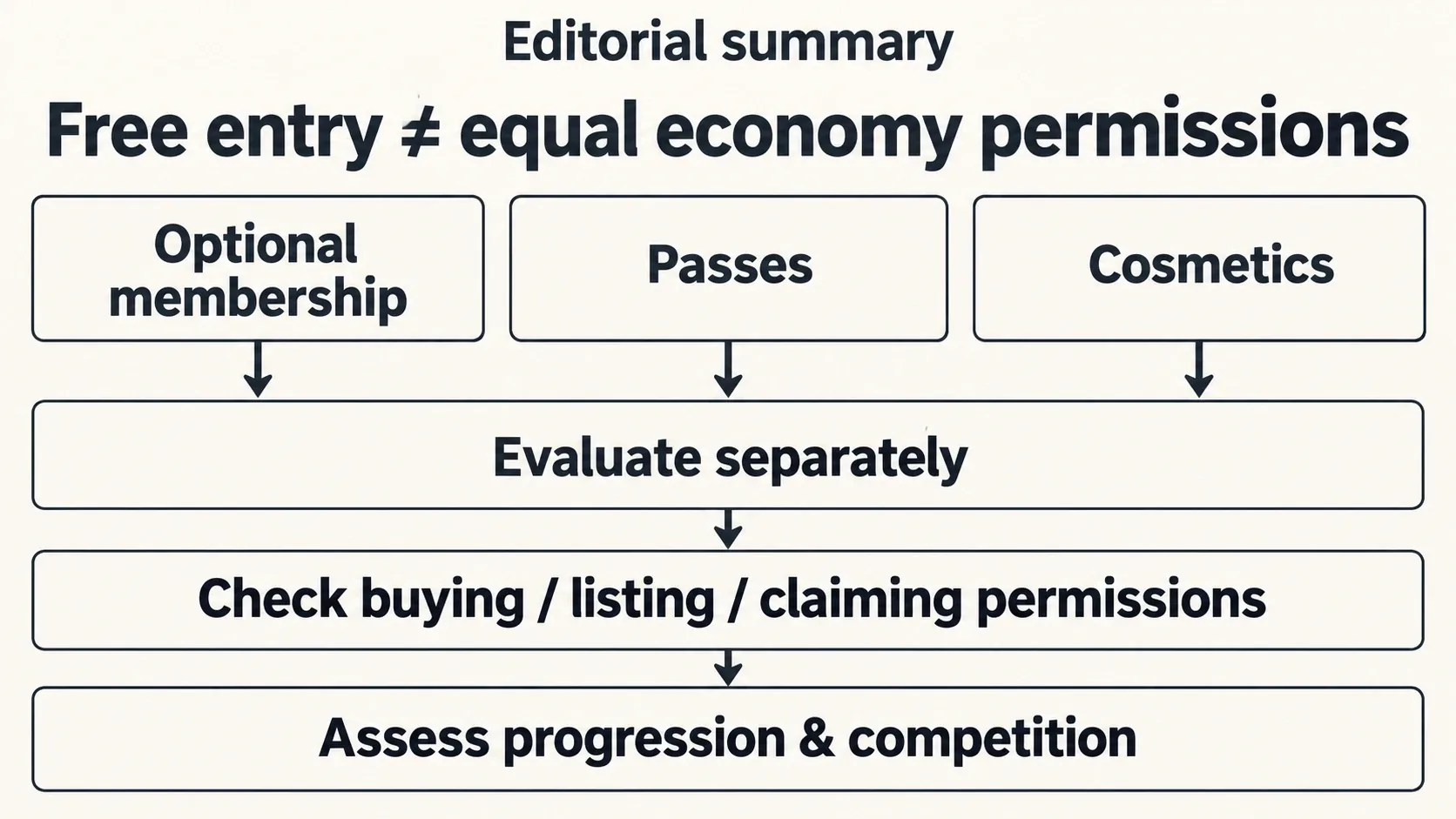
Editorial framework for evaluating the effect of paid access rather than equating entry price with equal permissions.
The membership is the most important element for a pay-to-win evaluation. A cosmetic changes appearance. Access to a trading economy or currency exchange can change what a player can obtain and how quickly they can obtain it. That is a functional advantage even when the underlying items originally enter the economy through gameplay.
The distinction between “free to play” and “equal economic access” is therefore essential. AION 2 Global does not require a subscription merely to launch the game, but the optional membership affects systems that matter to long-term progression. A free player can participate in the game without receiving every permission available to a member.
Current evidence does not establish one permanent membership price, a fixed exchange cap, or a complete list of purchasable progression outcomes for every future patch. Those details should be checked in the live Global client before making a spending decision. Korean and Taiwanese systems should not be substituted for Global rules.
How Paid Access Can Become an Advantage
The economic route is more important than any single shop listing. The basic chain works like this:
- A player purchases Quna with real money.
- Membership grants access to the relevant player economy and currency exchange features.
- The player can use that economic access to obtain Kina or participate more fully in the market.
- Kina can then support purchases connected to progression, subject to current listings, supply, eligibility, and Global restrictions.
This is why the phrase “everything is earnable through normal gameplay” does not settle the issue. An item can originate from gameplay while still creating a paid advantage when one player can reach it faster by converting money into economic purchasing power. The advantage is time and access, not necessarily a cash-exclusive item.
The opposite exaggeration should also be avoided. A currency exchange does not prove that every best-in-slot item is always listed, affordable, tradable, or usable immediately. It also does not prove a fixed number of days by which a spender will lead a free player. Market prices, available stock, progression requirements, and character-specific needs can all limit the result.
A useful way to judge the system is to follow the outcome rather than the name of the purchase:
| Paid feature | Direct outcome | Possible progression effect | What remains uncertain |
|---|---|---|---|
| Cosmetic purchase | Changes appearance | None established from cosmetics alone | Whether a particular bundle contains anything beyond cosmetics |
| Premium Battle Pass | Adds a paid reward track | Depends on the current rewards and whether they affect power, resources, or only appearance | Exact current reward value and future seasons |
| Membership | Unlocks economy and currency-exchange access | Broader access to trading and paid economic conversion | Current limits, fees, and the value of available listings |
| Purchased Quna used through exchange | Converts spending into in-game economic power | Can make useful resources or market goods more accessible | How much practical power a given amount buys at current market conditions |
If the final column cannot be verified in the current Global client, do not replace it with numbers from another region, the original AION, a test build, or a forum prediction.
Where the Advantage Matters Most
Paid progression does not affect every player equally. Its importance rises when character power is compared against other players or used as an informal gate.
Casual and solo-focused play
A player interested mainly in the world, story, flight, exploration, and gradual PvE progression may be able to ignore much of the competitive pressure. The publisher confirms that AION 2 can be played solo or with friends, although that statement does not mean every activity is designed for solo completion.
For this player, the important question is whether the free progression pace remains enjoyable. Another player reaching stronger gear sooner does not automatically prevent you from completing your own objectives. Membership may still be attractive for trading, but it is easier to treat it as optional when you are not racing a server economy or competitive ladder.
Group PvE progression
AION 2 includes five-player Expeditions and larger group content. In group PvE, economic acceleration can matter indirectly. Better access to useful market goods may help a player improve sooner, meet community-created recruitment expectations, or enter harder content with a more developed character.
Money does not teach boss mechanics, positioning, timing, or party responsibilities. It also does not guarantee acceptance into every group. Nevertheless, when equipment and broader character development influence recruitment, faster paid progression can create a practical advantage before the fight begins.
This page does not set a gear-score target or enhancement plan. Those decisions belong to the dedicated combat-power, gear-score, and enhancement guides because their answers require more specific progression evidence.
PvP and competitive comparison
Paid economic advantages are hardest to dismiss when character power is tested against other players. AION 2 includes faction PvP in the Abyss, but the current evidence does not support a blanket claim that every PvP mode uses the same power rules. It would therefore be inaccurate to say that all PvP is equalized or that every encounter is entirely gear-driven.
The safe conclusion is narrower: whenever a competitive activity preserves meaningful character progression, a faster route to resources or equipment can affect the contest. If your goal is top-end PvP, rankings, or keeping pace with the strongest characters, the membership and currency exchange deserve more weight in your decision than they would for a casual explorer.
Claims the Current Evidence Does Not Support
Several dramatic claims circulate in community discussions, but they should not be treated as established Global mechanics.
There is no solid basis here for publishing a universal dollar cost to maximize one item, a guaranteed time difference between spenders and free players, or a claim that a paying character can defeat a specific number of opponents. Assertions about paid dungeon resets, instant-clear tickets, resurrection advantages, unlimited farming, or exact weekly run totals also remain unconfirmed for the current Global service.
The available evidence likewise does not prove that spending is irrelevant. The official Global description confirms that membership affects the player economy and currency exchange, so the model cannot honestly be reduced to optional skins. The unresolved part is the magnitude of the advantage, not the existence of monetized economic access.
Future fears should remain separate from current mechanics. NC’s history or another region’s monetization may influence your level of trust, but neither proves what a future Global patch will contain. Evaluate announced Global changes when they arrive instead of presenting predictions as active shop features.
A Practical Spending Test
You do not need to decide from the label alone. Use the first stage of play to identify whether money changes an outcome you personally value.
- Choose your actual goal. Separate casual exploration, cooperative progression, market trading, and competitive PvP. A paid advantage that is minor for one goal may be decisive for another.
- Play without converting money first. Observe which restriction you actually encounter. Do not buy a membership merely because another player says it is mandatory for an unrelated playstyle.
- Inspect the live membership permissions. Confirm that the displayed Global benefits match your needs, especially access to the economy and currency exchange. Do not rely on Korean or Taiwanese screenshots.
- Read the current Battle Pass reward list. Classify each reward as cosmetic, convenience, or progression-related. The name “Battle Pass” alone does not reveal its competitive effect.
- Trace the full purchase outcome. If Quna becomes Kina, check what the resulting Kina can currently buy for your character and whether those goods materially advance your goal.
- Compare time saved with power gained. Saving time on a cosmetic collection is different from accelerating equipment that affects group eligibility or PvP performance.
- Set a fixed spending boundary. Treat membership, Battle Pass purchases, and currency conversion as separate decisions rather than one automatic monthly package.
- Recheck after major monetization changes. A fair judgment at launch can become outdated if exchange rules, pass rewards, market permissions, or shop inventory change.
This method also prevents two common mistakes: declaring the game harmless because purchases are optional, and declaring every convenience purchase an automatic combat victory. Optional spending can still create an advantage, but the practical size of that advantage must be connected to a real player outcome.
Playing Without Paying
A free player should expect to progress through gameplay while having less economic access than a member. The sensible approach is to build around the systems that remain available instead of planning around an exchange you cannot use.
Focus first on normal questing, character progression, repeatable PvE, and supported permanent upgrades. Avoid comparing your first days with players who bought Early Access bundles or who are actively converting money through the economy. Early Access ended before the October 5 Global launch, so it is now historical rather than an ongoing paid head start.
When progression slows, identify the exact cause. A shortage of Kina, missing equipment, an enhancement decision, limited reward energy, and a failed boss mechanic are different problems. Membership may change economic options, but it does not automatically solve poor resource allocation or incomplete character systems. Use the dedicated progression guides for level 45 priorities, Odyle Energy, combat power, and gear enhancement rather than treating every obstacle as a payment wall.
The separate free-to-play guide owns the detailed entry-cost and account-access comparison. The Founder’s Pack guide covers the old bundle rewards. For the pay-to-win decision, the essential point is that starting free is possible, while remaining fully outside membership means accepting reduced access to the trading economy and currency exchange.
The Bottom Line
AION 2 Global is not a cosmetics-only game. Its optional membership opens the player-driven economy and currency exchange, and premium currency can feed into an economic route that affects progression. Under a broad and widely used definition, that is enough to call the game pay to win or, more precisely, pay for advantage.
What cannot be supported is the stronger claim that every spender automatically wins, that every important upgrade can be bought, or that free players cannot enjoy the game. Your final answer should depend on where you compete. Casual solo players may tolerate the difference; market-focused, progression-focused, and PvP players have stronger reasons to object.
If your rule is “real money must never improve gameplay power or progression speed,” AION 2 fails that test. If your rule only rejects cash-exclusive, unbeatable power, the current Global evidence does not establish that stronger condition. Either way, judge the live membership, exchange, and Battle Pass outcomes—not the cosmetic shop alone.
Next Guides
Separate free entry, pack entitlements, and cosmetic appearances from competitive benefits.